Mechanisms of Morphogenesis
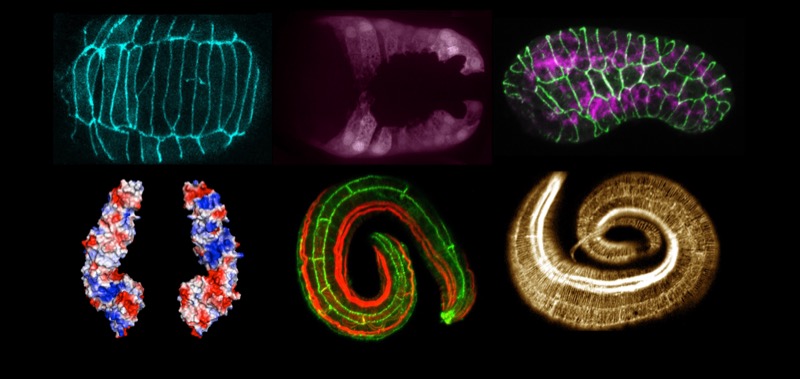
Images in the banner (from left to right and top to bottom): DLG-1/Discs large::GFP during dorsal intercalation [M. Köppen]; Pdlg-1::GFP during ventral enclosure [M. Sheffield]; AJM-1 (green) and muscle (red) during elongation [P. Heid]; HMP-2/beta-catenin electrostatic surface [H.-J. Choi]; AJM-1 (green) and muscle (red) in an elongated embryo [A. Cox-Paulson]; phalloidin staining in elongated embryo [M. Costa]
Welcome to the Hardin Lab!
We use the nematode, C. elegans, as a model system for investigating fundamental principles that allow embryos to build their body plans. We focus on investigating cell movement and cell adhesion during development. Understanding how cells move, and how they make and break adhesions has important implications for understanding birth defects during human development and for understanding cancer progression. Check out the Research page for more, or the News page for recent updates.
Our work is supported by the National Institute of General Medical Sciences, NIH (current award #R35 GM145312).

CONTACT
Jeff Hardin • Raymond E. Keller and Wayland Noland Distinguished Professor
Department of Biology, University of Wisconsin–Madison
327 Integrative Biology Research Building • 1117 W. Johnson St. • Madison, WI 53706
voice: (608) 262-9634 • lab: (608) 265-2520 • email: jdhardin(AT)wisc.edu
GRADUATE PROGRAMS
Integrative Biology | Biophysics | Cellular & Molecular Biology | Genetics | Molecular & Cellular Pharmacology
Interested in working with our team? We’re always interested in talking with highly motivated scientists. Click here for more information…